
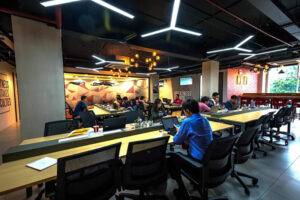
MANILA outperformed nine Asia-Pacific (APAC) cities in flexible workspace demand this year as multinational companies and business process outsourcing firms pursued more cost-efficient workspace strategies, according to a report by The Instant Group, a global advisory firm specializing in flexible workspaces.
The Philippine capital recorded a 51% surge in demand for flexible workspaces, making it the region’s fastest-growing flexible workspace market for 2025, the company said in a statement last week.
“The city’s strong talent pool and expanding commercial districts accelerated the shift to flexible workspace,” it said.
Manila ranked ahead of Sydney, Australia (46% demand increase); Melbourne, Australia (34%); Kuala Lumpur, Malaysia (25%); Tokyo, Japan (23%); and Shenzhen, China (19%).
Other cities in the top 10 were Hyderabad, India (9%); Auckland, New Zealand (6%); Singapore (5%); and Taipei (3%).
Manila’s flexible workspace segment is largely driven by startups, freelancers, and virtual assistants, Joey Roi H. Bondoc, director and head of research at Colliers Philippines, said in a phone interview.
“Relatively, flexible workspace rates are still more attractive here in the Philippines compared to more developed markets in Asia,” he said.
In the Philippines, flexible workspaces expanded at an annual rate of about 30% to 236,000 square meters (sq.m.) by the end of 2019, from just 10,000 sq.m. in 2011, Colliers said in a report.
As of end-September, the flexible workspace sector added 49,000 new seats in Metro Manila alone, according to third-quarter market data from Colliers Philippines.
Fort Bonifacio recorded the highest number of flexible workspace seats at 14,900, followed by Makati City (13,500), Quezon City (8,700), Ortigas Center (7,000), Mandaluyong City (2,100), Alabang (1,800), and the Bay Area (1,000).
Across the Asia-Pacific region, both small and large organizations are increasingly turning to flexible, cost-efficient workspace solutions to support hybrid teams, The Instant Group said.
More companies globally adopted flexible workspaces in 2025 to reduce operational risk while supporting collaboration and social connection among employees, it added.
The report also noted the rise of suburban work hubs supporting the work-near-home trend.
“Rising flexible workspace demand across APAC’s fastest-growing cities shows how quickly the region shifted toward more dynamic workplace models — and we expect this momentum to accelerate well into 2026,” said Paul Marshall, The Instant Group’s executive director for managed Asia-Pacific. — Beatriz Marie D. Cruz
