
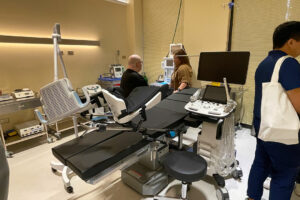
The growing demand for the In Vitro Fertilization (IVF) procedure in the Philippines is mirroring the shifting broader global socio-demographic trends, according to an expert.
“In this country, there historically haven’t been that many clinics proportional to the overall population and so for us, we saw it as a market that was relatively underserved,” GenPrime Manila and Rhea Fertility Founding Chief Executive Officer Margaret Wang told BusinessWorld in an interview.
“It’s been a long part of the Philippine culture to actually build families…I think there’s just a lot of unmet demand,” she added.
IVF is a complex medical procedure where a mature egg is combined with sperm in a laboratory to produce a fertilized egg called an embryo. The embryo will then be placed back in the womb to implant itself and proceed with the pregnancy.
“For IVF, it’s not 100% accurate that you’ll get pregnant…For the Philippines, around 40%,” GenPrime Manila Head Nurse Stephanie C. David told BusinessWorld in an interview.
“It’s really a risk to take, but then it’s also a hope, it’s a chance to have your family, it’s still a 40% out of zero,” she added. “It’s something that we aim to give couples a chance to have a whole family.”
The growing popularity of IVF among Filipinos is attributed to the evolving socio-demographic patterns of Millennials and Generation Z (Gen Z) globally, driven by career aspirations.
“I think today a lot of Millennials and Gen Zs, they’re very career-driven in that way. The mindset is kind of like let me build my career first, and then think about building a family,” Ms. Wang said.
“The people today are waiting longer to have children, they may also be getting married later for the same reasons, or it’s just that they may know that they want to build a family, but not yet,” she added.
A report by research and analysis firm BMI revealed that the Philippines is forecasted to have the highest number of Generation Alphas in major Asian economies by 2030.
The report noted that Asia will account for 50% of the global Gen Alpha population, estimated at 935.7 million, with 27% of Asia’s population expected to come from the Philippines by 2030.
Gen Alpha is born between 2010 and 2024, succeeding Gen Z. — Almira Louise S. Martinez
