
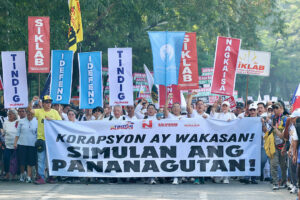
The Philippines’ political dynamics and institutions differ greatly from those of the key Arab Spring states. Unlike the largely authoritarian regimes in the Middle East, the Philippines remains a functioning — if flawed — electoral democracy. Yet the parallels are hard to ignore. Public frustration with corruption, patronage politics, and deeply entrenched political dynasties echoes many of the grievances that fueled the uprisings across the Arab world in December more than a decade ago.
Here, as in the Middle East, dissatisfaction has been building for years. The once-clear lines between political and business elites have blurred, creating an oligarchic bloc whose power is self-reinforcing. For many Filipinos, these elites represent the core of our democratic deficit. This is the combustible mix we face today: institutionalized corruption, weak governance, and a society whose patience is steadily wearing thin.
The recent flood control scandal exposed how deeply corruption has penetrated public institutions. It also opened a rare window for demanding accountability and reform. The real challenge now is how to sustain the gains from the public’s anger and engagement — how to ensure this moment becomes a springboard for structural change rather than a fleeting episode of outrage.
Books examining the Arab Spring, including Mark Haas and David Lesch’s Arab Spring: The Hope and Reality of the Uprisings (2016), consistently outline four reasons why the uprisings failed to produce lasting democratic transitions: one, entrenched authoritarian structures that proved resilient; two, fragmented civil society and reform movement with conflicting goals; three, deteriorating business conditions that further deepened instability; and transition fatigue and backlash.
These lessons are useful as we grapple with our own “Trillion Peso Spring.” They prompt a sober question: Will this moment of awakening lead to meaningful change, or will it dissipate into a long and discouraging “Trillion Peso Winter?”
There is no denying that corruption and bad governance in the Philippines are systemic. They are not merely persistent — they are durable. The electoral process is often influenced long before votes are cast, shaped by political dynasties and business powerbrokers who can buy influence and secure leverage across branches of government. Without decisive action now, the momentum generated by current investigations could fade, and the names implicated in official documents or whistleblower accounts may soon be forgotten. History has shown that even convicted officials have managed to return to power, resurrecting political careers as if nothing had happened.
Many authoritarian Arab regimes entered the uprisings with similar levels of entrenched patronage networks, weak civil society, and fragile democratic traditions. With such brittle foundations, the initial wave of protests proved difficult to convert into sustainable institutions of accountability.
Contrary to the belief that corruption is a concern only of the elite or the middle class, recent Pulse Asia findings (September 2025) show that Filipinos rank the fight against graft and corruption as the second most urgent national concern, just after inflation. More than half of respondents are deeply troubled by corruption, placing it even higher than concerns over wages, criminality, poverty, illegal drugs, and jobs.
If the flood control scandal has done anything, it is to expose how corruption permeates multiple layers of governance, from the highest offices down to local bureaucracies. This recognition has emboldened many citizens. The strong turnout at both the Sept. 21 and Nov. 30 Trillion Peso Marches showed that Filipinos are not alone in their frustration; many are ready to uphold truth, transparency, and accountability.
For some, the magnitude of corruption may feel overwhelming, inspiring resignation rather than resistance. But for many others, this moment demands vigilance, a renewed commitment to confronting corrupt officials and institutions until genuine reform is finally achieved.
Yet the Arab Spring reminds us that division can be fatal to reform movements.
Fragmentation plagued many of the uprisings, and similar strains are visible here. The Luneta and EDSA rallies, though united in demanding integrity and accountability, disagreed on the call for President Ferdinand “Bongbong” Marcos, Jr. and Vice-President Sara Duterte to resign. The Luneta demonstrators insisted on leadership accountability and systemic reforms, including the abolition of political dynasties and the restitution of stolen public funds. Meanwhile, the EDSA rally supported the fight against corruption but distanced itself from the demand for resignations, expressing fears of unintended consequences such as a transition council, revolutionary government, or civilian-military junta.
Cardinal Ambo David’s statement acknowledged this tension while keeping channels of unity open. His words — “we do not yet believe in the call of the people who are in Luneta” — suggested caution, not rejection. This openness creates space for reconciliation rather than division, a critical ingredient for sustaining any reform movement.
Groups like 1Sambayan echoed the Cardinal’s position, emphasizing accountability, peace, and constitutional order. They rejected attempts at extraconstitutional regime change and warned against divisive politics amid economic and political instability.
The truth is that EDSA and Luneta share far more goals than differences.
Efforts should focus on strengthening common ground while constructively addressing disagreements. There is no deep ideological chasm separating the two — only differing views on political timing and the sequence of reforms. Some actors have in fact begun to exploit these divisions to push for outcomes such as a forced resignation that could favor particular political factions. But public discourse must stay anchored in evidence: if documentation is stronger in support of an impeachment case against the Vice-President than the President, then the political narrative should reflect that reality rather than partisan speculation.
To move forward, we need institutional spadework. Key legislative reforms must include enforcing constitutional prohibitions against political dynasties, passing electoral reforms to strengthen campaign finance rules and transparency, mandating lifestyle checks for public officials, and overhauling budget processes to prevent insertions and abuse.
The Arab Spring also revealed that political uprisings cannot succeed without addressing underlying economic issues. Many of the protests in the Middle East were fueled by unemployment, stagnation, and declining living standards. Similarly, in the Philippines today, the economic context adds urgency and complexity. If the Trillion Peso March leads to accountability but fails to bring improvements in economic growth, job creation, business confidence, and living conditions, sustaining the movement’s momentum will be difficult. The BusinessWorld Forecast 2026 captured this anxiety: we are confronting a “corruption crisis combined with political volatility” that is eroding business confidence.
The public now demands resibo — tangible proof that reform is not just political theater. Citizens want to see rising incomes, stable prices, sustainable fiscal policy, stronger healthcare and education systems, improved social infrastructure, declining poverty, better public services, lower cost of doing business, and more productive employment opportunities.
Revolutions and regime changes often falter when they fail to deliver results. The Arab Spring demonstrated that enthusiasm can quickly turn to disillusionment when transitions do not yield better governance or improved livelihoods. In several Arab countries, initial optimism was followed by civil liberties shrinking again as old elites reasserted their power.
This transition fatigue is real and dangerous.
We must guard against such a trajectory. Many Filipinos already feel that the spirit of EDSA 1986 was squandered, leading to cynicism about regime change and skepticism toward constitutional reforms. The belief that simply amending the Constitution will usher in transformative change reflects a recurring misunderstanding of what it takes to build strong, accountable institutions.
If we fail to address weak institutions, fragmented civic movements, deep socio-economic challenges, and the risk of transition fatigue, our aspirations will falter. What began as a Trillion Peso Spring — an awakening to the possibility of unity, integrity, and reform — could easily descend into a Trillion Peso Winter marked by disappointment and continuing upheaval.
But it does not have to. The window is open. It is narrow, but real.
The test before us is whether we can seize this moment, sustain the unity necessary to demand meaningful reforms, and strengthen the institutions needed to guard against future abuses. The future of the Trillion Peso Spring depends not on a single march or a single scandal, but on our collective ability to translate anger into action and action into durable, credible change.
Diwa C. Guinigundo is the former deputy governor for the Monetary and Economics Sector, the Bangko Sentral ng Pilipinas (BSP). He served the BSP for 41 years. In 2001-2003, he was alternate executive director at the International Monetary Fund in Washington, DC. He is the senior pastor of the Fullness of Christ International Ministries in Mandaluyong.
