
By Lito B. Zulueta
THE 28th edition of the Singapore Writers Festival (SWF), which ran from Nov. 7 to 16, made a stab at the future with its special focus on sci-fi, fantasy, and speculative writing, featuring marquee names associated with the popular genre such as the Americans Ken Liu and R.F. Kuang and the Philippines’ own Dean Francis Alfar.
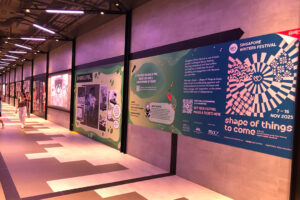
The futurist thrust of Southeast Asia’s biggest writers’ powwow coincided with the 60th anniversary of Singaporean independence. Billed as SG60, the nationwide celebration has been a look at the future as much as the past. In fact, the SWF 2025 theme was “Shape of Things to Come,” derived from H.G. Wells’ 1933 futurist novel.
SWF director Yong Shu Hoong said the theme “encapsulates my reflections” on SG60. “On one hand, it’s a chance to look back at past struggles and achievements with the wisdom of hindsight,” he said. “On the other, we’re tapping the confidence gained through the years to press forward with optimism and hope.”
The festival’s new Sci-fi Spotlight track, he added, “opens a portal into a brave new world where science fiction can help us speculate on possibilities for our future across technology, society, and culture.”
SPECULATIVE SPOTLIGHTThe spotlight on speculative fiction featured two of the genre’s most influential figures: R.F. Kuang and Ken Liu.
Ms. Kuang — best known in Manila for her Poppy War trilogy of historical fantasy novels — turned her keynote toward academia, drawing from her new grimdark-academia novel Katabasis, a thematic companion to Babel.
She dismantled what she called three myths of higher education: that universities guarantee social mobility, reward merit, and nurture political resistance. “US universities have always been bastions of the elite,” she said.
She contrasted student radicalism with administrative conservatism: “Students are historically agents of revolution, but when they protest injustice, administrators send the police — or even the National Guard.”
In Katabasis, Ms. Kuang makes the PhD candidate journey a literal descent into hell, yet the author remains hopeful. “You criticize an institution because you love it,” she said, urging public investment, academic living wages, and relief from student debt.
Mr. Liu, meanwhile, meditated on art, technology, and originality. Drawing from Aristotle and Walter Scott, he argued that Western aesthetics once regarded copying — not novelty — as central to art.
Scribes and engravers, he noted, were interpretive craftsmen whose work was later displaced by printing and photography. “If an art’s highest ideal is the reproduction of an original, it is subject to mechanistic replacement,” he said.
Turning to translation, Mr. Liu contrasted human interpretation, such as Emily Wilson’s gender-conscious translation of Homer’s Odyssey, with AI’s capacity for “consensus translations.”
For Mr. Liu, AI is not a threat but another creative inflection point — one that could open “new genres of art not possible in its absence.”
SINGAPORE’S EARLY SCI-FI LINEAGEA surprising historical depth emerged at “From Colony to Cosmos,” where writer Ng Yi-Sheng traced Singapore’s sci-fi roots to the 1898 tale “The Travels of Chang Ching Chong” from The Straits Chinese Magazine. Researcher Nurul ’Ain Razali pushed the timeline further back to mythic episodes in the 17th century Sulalatus Salatin.
Along with playwright Stella Kon and novelist Raju Chellam, the all-Singapore writers panel mapped a lineage shaped by colonial anxieties, rapid modernization, and evolving regional identity — a reminder that Southeast Asian futurism long predates independence.
BUILDING WORLDS, GROUNDED IN EMOTIONWorld-building took center stage at “Between Real and Imagined,” where Ellie Marney, Ben Oliver, and Filipino speculative pioneer Dean Francis Alfar debated how to balance invention with authenticity.
Mr. Alfar emphasized emotional grounding, arguing that even the most fantastical settings become believable when anchored in human experience.
His warmth and humor won the audience; when his books sold out, he signed notebooks and even scraps of paper for his fans.
Best-selling American YA author Neal Shusterman spoke to young readers and writers about empathy, character-driven storytelling, and handling tough topics responsibly.
With his best-selling 2016 novel Scythe optioned for a TV series adaptation by Universal Studios, he shared tips on embracing diverse perspectives, balancing intensity for teen audiences, and using AI creatively.
Mr. Shusterman’s advice: stay curious, protect your voice, and let compelling characters lead the way.
GENRE VOICES OVER LUNCHAt the Salon at Brasserie Astoria, Singapore poet Marylyn Tan and Philippine crime novelist F.H. Batacan shared an intimate literary lunch.
Ms. Tan opened with her darkly funny poem “Nasi Kang Kang” (from her 2022 collection Gaze Back), using folklore and witchcraft to probe misogyny and the policing of bodies.
Ms. Batacan discussed her new novel Accidents Happen, published again by New York crime fiction publisher Soho (that published her celebrated debut novel, Smaller and Smaller Circles), highlighting how Philippine crime fiction departs from Western formulas, shaped instead by poverty, inequality, and the country’s flawed justice system.
The dialogue showed how Southeast Asian genre writing can be bold, political, and rooted in lived realities.
MEMORY, ETHICS, AND NARRATIVES WE INHERIT“The Stories We Inherit,” featuring Colombian Ingrid Rojas Contreras and Singapore writers Claire Wong, Sim Ee Waun, and Anitha Devi Pillai, shifted the focus to memoir and the ethics of retelling.
The panel explored the fragility of memory, silences in family history, and the responsibility writers bear when shaping inherited narratives.
Social-media feedback praised the panel’s candor, especially its insistence that creative license — when used with care — can reveal emotional truths without falsifying lived experience.
TURNING CRINGE INTO CONNECTIONBeyond the main venues, the festival expanded to Funan Underground with Nurjannah Suhaimi’s graphic-narrative exhibit That Time I Cringed So Hard I Ended Up on These Walls.
The comic follows Apollo, a young boy on a whimsical sci-fi quest to confront his most embarrassing memories.
For Ms. Nurjannah, the work was a reclaiming of awkwardness — an invitation to see vulnerability not as failure but as shared humanity.
Across panels on technology, memory, and identity, the festival positioned Singapore and Southeast Asia within a long continuum of storytelling — proving that envisioning tomorrow begins with understanding the stories we choose to remember and retell today.
